
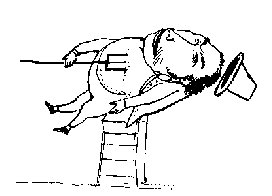
 Edward Lear was a master of ‘absurdest humor’ and was especially known for his nonsense verse and limericks, the latter of which he is credited with inventing. Edward Lear was also an illustrator and, of course in every sense of the word, an artist. Art is a form of an expression. And, expression is good, for with out it we are left with only silence and ultimately we become victims of repression.
Repression, of course, can be externally imposed by institutions of a political or social nature. But self-repression is yet another ugly form of the beast. When we begin swallowing our feelings or thoughts on a regular basis, we risk adopting passive-aggressive tendencies. Overtime, pressure builds and we ultimately lash out in perhaps less than appropriate ways. When this happens, it is for our anti-social behavior that we become most remembered for, rather than our moments of reserve.
Of course, there is a time and place for everything and being tactful always helps! Indeed, no one likes a chronic complainer. Nevertheless, being ’emotionally intelligent’ of how we feel and how our actions affect others is not some thing we are born with, but rather it is something we must learn. It’s something that also needs to be nurtured throughout our lives.
So the next time your students say to you “I can’t think of anything to write about” it might be a good time to begin reflecting upon how comfortable your students are expressing themselves to you. Of course, a bit of context and topic/vocabulary brainstorming work always helps our students, too!
Below are some limericks by Edward Lear* (in bold italics) and some of my own ‘bits of nonsense’ I came up with upon some soul searching and self-reflection. I hope they inspire you to write some of your own and I hope you have as much fun as I did writing these, and sharing them with my students! Don’t forget to encourage them to do the same.
There was an old man with a gong,
who bumped at it all day long;
But they called “Oh Law!, You’re a horrid old bore!”
So they smashed that old man with a gong.
There was a grammarian of methodology
whose notions of grammar were quite dodgy.
Though his students lay snoring,
he continued his ‘boring’.
That mind-numbing teacher of grammar.
There was an old man with a flute.
A ‘sarpint’ ran in his boot;
But he played day and night,
Till the ‘sarpint’ took flight,
And avoided that man with a flute.
There was young foreigner of methodology
whose methods were thoroughly dodgy.
When his students called for the ‘Rules’,
he rebuked them then “You fools!
You will never learn English by folly.”
There was an old man in a boat.
Who said, “I’m afloat! I’m afloat!”
When they said, “No you ain’t!”
He was ready to faint,
That unhappy old man in a boat.
There was a young man from Miami
whose notions of education were quite dandy.
Though his students said “Yes!”
Some colleagues said “Surely, you jest!”
That daring young man from Miami.
Suggested Reading:


* Edward Lear’s limericks from “The Book of Nonsense” was first published in 1845.
 ELTvisa
unfortunately sometimes we tend to forget that our students are not machines or robots but they also have emotions and we should keep that in mind!
LikeLike
Yes! That’s so true. It’s a shame many teachers seem to be conditioned to reject answers that do not necessarily comply with their, or their coursbook’s rigid expectations. We need to be more flexible and give students credit for their creativity. And, we certainly need to be more sensitive to our students feelings! Good comment!
LikeLike
A student must always feel free
To coment on whatever he sees
This might make you mad
Cause you know it’s going to be bad
But it’s only just a tease!
LikeLike
LOL! Good one! Any contribution by students should always be welcome!
LikeLike