ELT Publisher of materials for TEFL & ESOL teachers. Resource for humanistic, personal, and professional development with articles by Jay Leonard Schwartz, et al.
It’s the holidays again, a time when EFL teachers go scrambling for holiday flavored gift ideas. Well, in the spirit of the season of giving, here’s an emotional intelligence laced speaking task that will also appeal to students with visual and kinesthetic learning styles.
The following are some drama based ideas that incorporate the use of hand gestures for communication purposes. There are probably a zillion reasons to try some of the following activities, but some of major ones include:
Pair or group work.
Students get to be creative and use their imaginations.
Students will personalize their contributions (give them some contexts to work with to make things more achievable, and keep their more attentive.
The tasks support varying learning styles: visual, kinesthetic, tactile.
The tasks support the Total Physical Response (TPR) approach.
They’re fun!
For Younger Learners (but not limited to) Level: beginner, elementary Language targets: animal vocabulary, present continuous
Ask students to study their hands. Instruct them to wriggle their fingers, open and close their hands, and try to move them in all ways possible. This warm up task helps get their imaginations going, while at the same time locks their attention levels on target.
Prompt your students to make animal or other creature figures with their hands and then ask a partner what they are making. You might want to demonstrate a few first, though. Start with a rabbit or a spider. I usually begin with a spider and then make it crawl up my arm, shoulder and eventually stopping it on my head. I not only ask students what it is, but also what it’s doing. Hopefully, “It’s sitting on your head!” is the reply! Make sure students answer at sentence level.
Making animal shadows on a wall is a timeless activity for young and old! In the classroom, you can that old overhead transparency projector or a newer powerpoint projector to get the job done.
You can also ask students, in pairs, to create a new animal or creature. They can come up to the class and not only demonstrate it, but also instruct the other students how to make it.
Standby tasks for all learners Level: Intermediate and above
What I’m suggesting here is basically a form of charades or miming tasks. All levels and ages tend to enjoy such activities. The focus here is on hand gestures and on trying to express ideas with one’s hands, or at least mainly with one’s hands. It’s not the end of the world if you incorporate facial or other body parts. Afterall, it’s only natural to do so in real life!
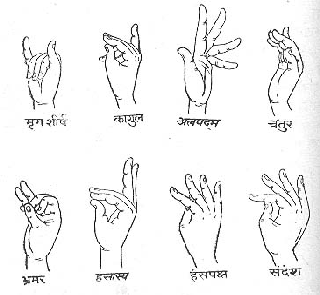
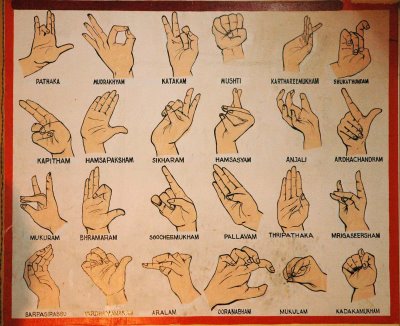
To get you started, study the following images. Some are naughty and some are nice. I leave it up to your discretion as to which you might ultimately use with your students!
The following photos reflect movements that stem from the dances of various cultures. Try some of these hand gestures and see if you can relate the gesture to some form of English expression. This is also something I’ve tried to do with my students, in a sort of free association type task.
At some point, what I try to do is get students to combine various hand gestures to express a statement, hopefully not a rude one! To a certain extent this may seem like mimicking ‘sign language’ for the deaf, which is another source that can be exploited, while at the same time fostering a greater appreciation for the hearing challenged.
Here are some basic example sentences I’ve used in the past:
How much does it cost?
It’s in the back.
I don’t hear you!
Stop, look and listen.
This stinks.
Watch the time!
What time is it?
I’m not listening.
Be Quiet!
Oww! That hurts!
Wait a minute!
Just a bit.
You’re crazy!
What were you thinking?
I should have known better.
I’m waiting.
I can’t wait!
Forget about it.
We’re number one!
Bring him/her/it over here.
I said, ‘here’!
No, not here, there!
Come on! Let’s pray together.
Please sir, may have some more?
Shame on you!
You’re in trouble!
Here is a video to also give you some ideas. This was produced by an organization teaching American Sign Language. Note here that the emphasis is on communicating at sentence level, which is really what we should be occupied with for the most part:
Lastly, try to incorporate music into the mix! Take a lesson from the following video. Go for more than just the title. Try incorporating the lyrics! Turn down the sound and see how many statements the mime is making. Try giving students the lyrics to a song and see if they can mime them.
These are just a few ideas you can do that involve hand gestures to get students involved using their bodies, while at the same time taking into account varying learning styles. It’s important to have fun with such tasks, but to also put the emphasis on communication and to manage the time appropriately. Charades, for example, is great fun. However, much non-productive time can ensue from students ‘performing’ and ‘observing’ as opposed to actually ‘speaking’. Therefore, it’s important to keep the balance time and fun wise. I hope these ideas work for you. If you have any related suggestions, please comment below.





 ELTvisa