ELT Publisher of materials for TEFL & ESOL teachers. Resource for humanistic, personal, and professional development with articles by Jay Leonard Schwartz, et al.
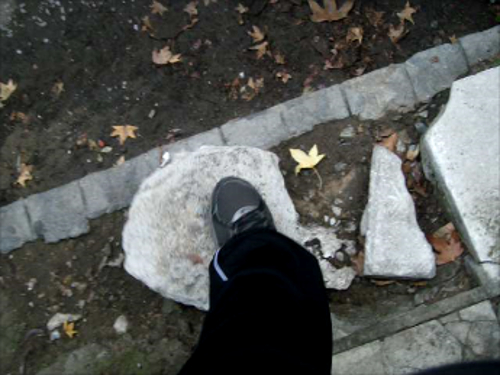
Sidewalk Fail is a humanistic oriented educational multimedia project which includes video, audio, music, and text-based content. It’s main aim is to provide English as a Foreign or Second Language (EFL/ESL) students with a lesson that promotes civic responsibility and engagement, as well as citizen journalism.
The teaching approaches combines integrated-skills work and as aspects of ‘social emotional learning’ to teach empathy for citizens who require special needs with regards to mobility, such as the physically disabled, the visually impaired, and the elderly.
The context of the lesson addresses sidewalks and pedestrian paths that are hazardous and inaccessible because of their poor condition due to government neglect, poor city planning and obstructions such as parked cars left by indifferent drivers.
The lesson tasks include, video work, integrated reading and listening comprehension, integrated reading and writing work, integrated pronunciation and sentence syntax work that is music based, and theme-based vocabulary and ‘use of English’ tasks. Speaking practice is facilitated through pair work tasks and class-level discussion with the teacher.
The lesson as a whole also serves as a call to action for a ‘citizen journalism’ type class project to address other local issues or problems.
It’s the holidays again, a time when EFL teachers go scrambling for holiday flavored gift ideas. Well, in the spirit of the season of giving, here’s an emotional intelligence laced speaking task that will also appeal to students with visual and kinesthetic learning styles.
The following are some drama based ideas that incorporate the use of hand gestures for communication purposes. There are probably a zillion reasons to try some of the following activities, but some of major ones include:
Pair or group work.
Students get to be creative and use their imaginations.
Students will personalize their contributions (give them some contexts to work with to make things more achievable, and keep their more attentive.
The tasks support varying learning styles: visual, kinesthetic, tactile.
The tasks support the Total Physical Response (TPR) approach.
They’re fun!
For Younger Learners (but not limited to) Level: beginner, elementary Language targets: animal vocabulary, present continuous
Ask students to study their hands. Instruct them to wriggle their fingers, open and close their hands, and try to move them in all ways possible. This warm up task helps get their imaginations going, while at the same time locks their attention levels on target.
Prompt your students to make animal or other creature figures with their hands and then ask a partner what they are making. You might want to demonstrate a few first, though. Start with a rabbit or a spider. I usually begin with a spider and then make it crawl up my arm, shoulder and eventually stopping it on my head. I not only ask students what it is, but also what it’s doing. Hopefully, “It’s sitting on your head!” is the reply! Make sure students answer at sentence level.
Making animal shadows on a wall is a timeless activity for young and old! In the classroom, you can that old overhead transparency projector or a newer powerpoint projector to get the job done.
You can also ask students, in pairs, to create a new animal or creature. They can come up to the class and not only demonstrate it, but also instruct the other students how to make it.
Standby tasks for all learners Level: Intermediate and above
What I’m suggesting here is basically a form of charades or miming tasks. All levels and ages tend to enjoy such activities. The focus here is on hand gestures and on trying to express ideas with one’s hands, or at least mainly with one’s hands. It’s not the end of the world if you incorporate facial or other body parts. Afterall, it’s only natural to do so in real life!
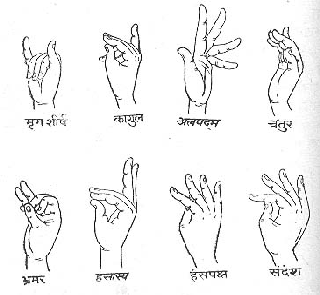
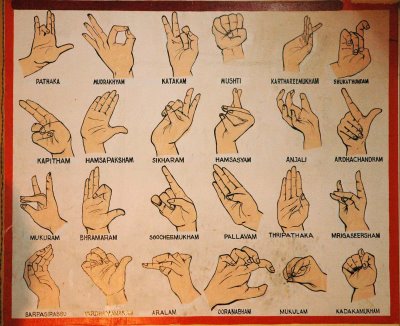
To get you started, study the following images. Some are naughty and some are nice. I leave it up to your discretion as to which you might ultimately use with your students!
The following photos reflect movements that stem from the dances of various cultures. Try some of these hand gestures and see if you can relate the gesture to some form of English expression. This is also something I’ve tried to do with my students, in a sort of free association type task.
At some point, what I try to do is get students to combine various hand gestures to express a statement, hopefully not a rude one! To a certain extent this may seem like mimicking ‘sign language’ for the deaf, which is another source that can be exploited, while at the same time fostering a greater appreciation for the hearing challenged.
Here are some basic example sentences I’ve used in the past:
How much does it cost?
It’s in the back.
I don’t hear you!
Stop, look and listen.
This stinks.
Watch the time!
What time is it?
I’m not listening.
Be Quiet!
Oww! That hurts!
Wait a minute!
Just a bit.
You’re crazy!
What were you thinking?
I should have known better.
I’m waiting.
I can’t wait!
Forget about it.
We’re number one!
Bring him/her/it over here.
I said, ‘here’!
No, not here, there!
Come on! Let’s pray together.
Please sir, may have some more?
Shame on you!
You’re in trouble!
Here is a video to also give you some ideas. This was produced by an organization teaching American Sign Language. Note here that the emphasis is on communicating at sentence level, which is really what we should be occupied with for the most part:
Lastly, try to incorporate music into the mix! Take a lesson from the following video. Go for more than just the title. Try incorporating the lyrics! Turn down the sound and see how many statements the mime is making. Try giving students the lyrics to a song and see if they can mime them.
These are just a few ideas you can do that involve hand gestures to get students involved using their bodies, while at the same time taking into account varying learning styles. It’s important to have fun with such tasks, but to also put the emphasis on communication and to manage the time appropriately. Charades, for example, is great fun. However, much non-productive time can ensue from students ‘performing’ and ‘observing’ as opposed to actually ‘speaking’. Therefore, it’s important to keep the balance time and fun wise. I hope these ideas work for you. If you have any related suggestions, please comment below.
Note: this article was written and first published online by out dear friend and colleague, ‘Teacher Dude’, on his blog: http://teacherdudebbq.blogspot.gr
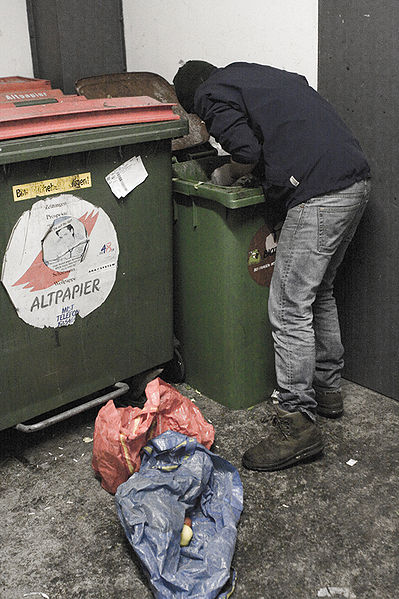
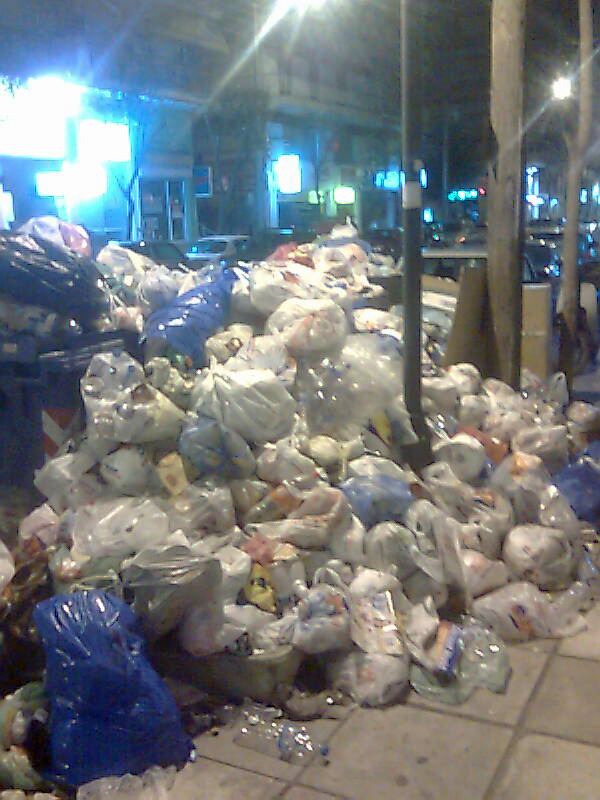
I once came across an article about ‘Freeganism’. It was titled “One Person’s Dumpster Is Another’s Diner” and was written by Becca Tucker, and posted on AlterNet on March 21, 2007. The article begins: “A subculture of people make a statement by living off the waste of millions.” For three days, a reporter gave it a dumpster-diving go in the “freegan” paradise of Manhattan.” I thought that it would make for an interesting lesson. As the article is quite long and complex this would be best done by advanced students.
Note: This article was written by our dear colleague & friend, Steve Vassilakopoulos.
In my previous post, I discussed how and why to use songs in the classroom, but my main focus was how the lyrics in a song can be exploited. However, there are, as the old saying goes, many ways to skin to a cat. If we go beyond the words a song contains and think about the music that a song contains, there are fertile pastures to be found there. In this article, I will explore two such ways of doing this, but having said that, there are numerous others as well.
The first use that we will look at is the use of music as context for narrative writing. And “what do you mean by that?” I hear you asking. Well, using music as context means providing music as inspiration to stimulate the imagination, lubricate the gray cells and get the old creative juices flowing. In practical terms it involves putting on a piece of music, setting a task for the students and then getting on with the feedback.
MATERIALS:
Photos of people (emphasis on facial features/ langauge), Dictionaries
PREPARATION:
Photo Sources: Photos may be cut from old magazines or found on the internet. Search Google.com. Type in ‘faces’ and click on images. You will find many to choose from. If a coursebook is used, leaf through it and note down the page numbers with some photos to refer to. Try to find a good range of photos to work with depicting varying facial expressions. Using celebrities will help build interest, but try to use non-celebrities, as well.
AIMS:
– To foster creative writing
– To help student brainstorm and write elements of plot, character profiles, settings, mood, etc.
– To brainstorm adjectives or other word forms
LEVEL: Elementary, Intermediate, Advanced
TIME: At least 20 minutes (depending on the amount of music played)
MATERIALS: Recorded pieces of music in a variety of musical genres
Using music to support language learning has many advantages, least of all that it supports those students who are more musical in terms of their learning style, and most of all because it makes learning fun and breaks up the monotony of regular day to day tasks.
There are many ways to use instrumental music to help students write creatively or to brainstorm vocabulary, especially adjectives and adverbs, and to help establish context. One of the easiest ways is to use pieces of instrumental music of different genres.
Most people love choices: left or right, onwards or homewards, yes or no, combined with the trepidation of ‘what if…?’ or ‘have I made the right decision?’ This task suggestion is loosely based on a series of novels published in the UK in the mid-1980s; novels in which the reader could decide the fate of the protagonist depending on decisions made or routes chosen.
The ultimate aim of the task, the desired learner outcome, is to facilitate a working knowledge of narrative tenses, modal verbs, conditional structures and vocabulary relating to character and adventure. The desired aim of the task, however, is to promote team-working skills, communication development and to have fun, a commonly neglected word! Amalgamating the two approaches needn’t be hard work for the teacher and the end product can be made into wall posters, a school presentation or a ‘take home and keep’ novella.
PROCEDURE:
– Tell the students that you have a story in mind and that they are to guess the storyline by asking yes / no questions. Give them a general theme for the story such by telling them its a “love story” or a “crime”, etc. You can also give them some brief details about the characters if you like.
– Tell the students to keep notes about your answers so that they can keep track of the details and piece the story together.
– Instruct the students they you will only answer “properly formed questions”.
– You do not need to have a story in mind at all! Simply answer ‘yes’ to every third question and ‘no’ to the others. When answering questions, give the impression that careful thought has been put into each response!
– After answering a number of questions (at least 20) put the students into pairs and have them write the story they believe you have thought of.
– Encourage students to be creative, if they claim they don’t have the details.
– Have each group read their story to the class – before you tell them the truth!
Note: The following article was written by our dear colleague & friend, Steve Vassilakopoulos.
A Call to Action: Kick Ass Ecology (It’s more than just a classroom task!)
As teachers of English, the de facto international language, what we should be doing is teaching our students the English they will need to help save the environment and the future of mankind. Now that’s a pretty noble mission, wouldn’t you say? A pretty important reason for our students to communicate with others in other countries, eh? After being in the business of teaching English for almost 25 years, I would have to say that we teachers in this country are still mostly required to prepare students for exams and activities that have to do with the environment are mostly considered useful because there might be a reading passage in one of the exams or perhaps it might be one theme for the speaking part of any given exam.

 Sidewalk Fail is a humanistic oriented educational multimedia project which includes video, audio, music, and text-based content. It’s main aim is to provide English as a Foreign or Second Language (EFL/ESL) students with a lesson that promotes civic responsibility and engagement, as well as citizen journalism.





 ELTvisa