 Sidewalk Fail is a humanistic oriented educational multimedia project which includes video, audio, music, and text-based content. It’s main aim is to provide English as a Foreign or Second Language (EFL/ESL) students with a lesson that promotes civic responsibility and engagement, as well as citizen journalism.
The teaching approaches combines integrated-skills work and as aspects of ‘social emotional learning’ to teach empathy for citizens who require special needs with regards to mobility, such as the physically disabled, the visually impaired, and the elderly.
The context of the lesson addresses sidewalks and pedestrian paths that are hazardous and inaccessible because of their poor condition due to government neglect, poor city planning and obstructions such as parked cars left by indifferent drivers.
The lesson tasks include, video work, integrated reading and listening comprehension, integrated reading and writing work, integrated pronunciation and sentence syntax work that is music based, and theme-based vocabulary and ‘use of English’ tasks. Speaking practice is facilitated through pair work tasks and class-level discussion with the teacher.
The lesson as a whole also serves as a call to action for a ‘citizen journalism’ type class project to address other local issues or problems.
LESSON AIMS & THEMES:
- Promoting civic responsibility and taking neighborhood action
- Motivating students towards citizen journalism
- Fostering social emotional learning
- Teaching empathy for the physically disabled and other citizens with special needs
- Teaching vocabulary related to civics and neighborhoods
- Letter of complaint writing
- Connected speech and ellipsis
- Working with music and lyrics
LEVEL: Lower-Intermediate and above
TIME: 90 minutes (suggested)
MATERIALS:
Materials Archive: A compressed ‘ZIP’ file which includes the following items:
- Worksheets (PDF file)
- Full Lesson Plan (PDF file)
- Photos for computer projection systems
Click Here To Download The Materials Archive!
Video: Sidewalk Fail – YouTube Link
Music Video: Walk N’ Roll – YouTube Link
Audio for listening comprehension tasks (on video), Sidewalk Fail Listening Task B – YouTube Link
Note: The videos above have been embedded in this post below. Also, The ‘Worksheets’ document in the material archive includes the following:
- Worksheet 1 – Video
- Worksheet 2 – Reading & Listening Comprehension
- Worksheet 3 – Vocabulary & Use Of English
- Worksheet 4 – Integrated Reading & Writing
- Worksheet 5 – Integrated Pronunciation & Syntax Focus
- Photos Handout
PREPARATION:
Print out worksheets 1 though 5, and the ‘photos handout’. Alternatively, use a computer based projection system to display the photos, included in the ‘materials archive’.
PROCEDURE:
Follow the lesson plan and teacher notes found in this post or in the material’s archive. This post includes details from the lesson plan, but not the worksheets. Please note that the answers to all tasks are printed in the ‘lesson plan’ in the materials archive and not in this online post.
LESSON INTRODUCTION
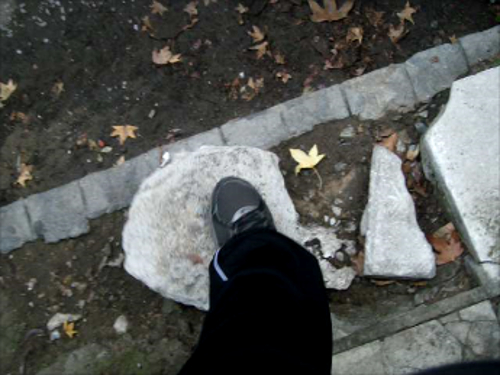
Show students the following photos, then ask them what common problem they all depict. The photos can be printed as handout printed from the ‘photos handout’, found at the end of the file titled ‘Worksheets’ from the ‘materials archive’. The individual photos are also included in the materials archive so that they may be displayed electronically via a computer-based projection system.
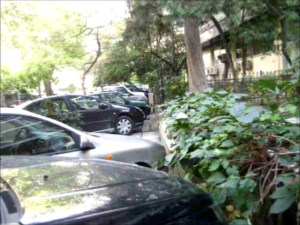
Sidewalk Fail – Photo 1
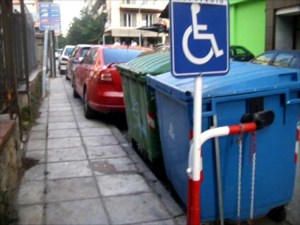
Sidewalk Fail – Photo 2
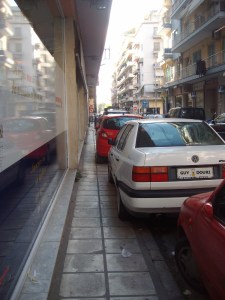
Photo 3
Personalize the lesson by asking students about their neighborhood. Ask all or some of the following suggested questions:
- Do you have sidewalks (the pavement) in front of your homes?
- Where do people park their cars?
- How easy is it to walk down the sidewalk?
- Do you have to walk in the street because of cars parked on the sidewalk?
- What do the sidewalks look like in your neighborhood? Are they broken?
- Whose responsibility is it to repair the sidewalks and streets?
- To what extent is it your responsibility to complain about problems in your neighborhood?
- Whom do you complain to?
- How can you complain?
Explain the term, ‘civic responsibility’. Definition: The civil responsibilities citizens have towards their community.
Teaching Empathy:
Direct the students’ attention to picture 2. Ask them about the blue ‘disabled parking’ sign. What special problem does the photo depict? Answer: there are garbage dumpsters and recycling bins in the parking spot reserved for the physically disabled. Then, ask students the following questions:
- How easy would it be for a person with a physical disability to walk down a block like this?
- What kind of problems would these people have moving about your neighborhood?
- What can be done to provide easy access for these people?
- Do you know any people with a form of disability?
- To what extent do you believe your city supports the disabled, especially to provide access to public areas and facilities?
Pre-teach the following words if needed:
Vocabulary Set 1: Disability related:
Disability, Impairment, Physical disability or impairment, Ramp, Visual impairment, Wheelchair, Wheelchair bound, Wheelchair access, Special needs
Vocabulary Set 2: General vocabulary
Baby stroller or carriage, Block, Citizen, Journalist, City Hall, City planners, Civic Leader, Coffer, Crosswalk (Pedestrian crossing), Curb, Electric or utility poles, Garbage dumpsters, Grating, Neighborhood, Obstacles, Pedestrian, Pot Holes, Public Facilities, Ramp, Recycling program, Resident, Sidewalk / Pavement, Senior Citizen, Stroll
VIDEO WORK: [Worksheet 1]
The following stage of the lesson includes a video titled, Sidewalk Fail: An exercise in citizen journalism and civic responsibility. Tell students they will watch a video about two teenagers who decided to make a video about problems with the sidewalks in their city.
Explain what ‘citizen journalism’ is. Definition: Activities that citizens do to play an active role in the process of collecting and reporting information about local or global issues and problems, especially those impacting their neighborhoods, towns or communities.
Video Note: It’s a good idea to stop the video from time to time to check for comprehension. The video is, for the most part, broken down into themed sections. The following is a list of time markers for the end point of each section, which might be good places to stop for comprehension checks.
| Video Content | Time Section Ends |
|
1. Introduction |
00:50 |
|
2. Poor sidewalks |
02:35 |
|
3. Poor city planning (school sidewalks with trees in the middle |
03:11 |
|
4. Empathy for people with physical disabilities or special needs |
03:59 |
|
5. Video game like montage of poor sidewalks |
05:52 |
|
6. Sidewalks blocked by cars |
06:41 |
|
7. Garbage dumps, ramps and recycling bins |
07:52 |
|
8. Conclusion |
09:45 |
Video Task A:
Using worksheet 1, tell students to complete the table as they watch the video. Tell students to tick the items they see or that the teenagers mention are obstacles in the sidewalk? Then, ask students which ones were mentioned by the teenagers.
Video: Sidewalk Fail – YouTube Link: http://www.youtube.com/watch?v=Xg1i5COc5zU
Task B:
After watching the video. Tell students to answer the questions on the worksheet with a partner. Students answer True (T), False (F) or Not Mentioned (MN). You may need to explain what ‘not mentioned’ means and how it differs from ‘False’.
Extra Discussion Task:
The speakers in the video quote the humanitarians below. Ask the students what they know about these individuals. Read the quotes, or write them on the board, and ask the students to explain their meaning and significance.
- Mother Teresa: “I alone cannot change the world, but I can cast a stone across the waters to create many ripples.”
- Reverend Martin Luther King, Jr.: “The time is always right to do what is right”.
- Tupac Shakur: “I’m a reflection of the community.”
Students can also be asked about other implied or visual references to people, movements or expressions stemming from popular culture. These include the following:
- Video gaming culture, specifically the expressions used, such as “Job Failed”, “Respect Is Everything” (Grand Theft Auto 2).
- The Guy Fawkes mask, as depicted in the video/comics V For Vendetta and adopted by the ‘Anonymous’ network of activists and hacktivists.
- A poster of Nadezhda Tolokonnikova, imprisoned member of the Moscow based feminist punk rock and art protest group, Pussy Riot, who is considered by many to be a political prisoner of conscience.
- The expression, “Power To The People” is a political slogan, originating in anti-establishment and equal rights moments. It is also the title of a song by John Lennon.
INTEGRATED READING & LISTENING COMPREHENSION [Worksheet 2]
Teaching note: Students will read a brief article about a proposal by city officials to provide more parking for residents. Tell students to read the article and then to discuss their opinions in pairs. Next, take a sample of the student opinions.
Task A:
Tell students to read the following excerpt from a newspaper article, found on Worksheet 2, and then to discuss with a partner their opinion of the Mayor’s proposal. Do they agree or disagree with his idea?
[Reading Text]
“Mayor Proposes A New Tax To Build More Municipal Parking Lots”
San Pueblo, California: At a public city planning meeting yesterday, city planners, led by Mayor Scouse, suggested that an answer to the city’s ever-growing traffic and parking problems is to pave over the former ‘Soldier Park’ in order to create a large municipal parking lot that will host over a thousand parking spaces. “I understand the needs and concerns of automobile owners very well. I myself have two cars and think we have to do a better job of providing more parking spaces”, said Mayor Scouse, “No one uses Soldier Park anymore and it has become nothing more than a haven for the homeless and drug addicts. It’s time we clean up this area and put it to good use.”
Addressing angry shouts by local residents protesting a possible new tax to raise funds for constructing the parking lot, the Mayor remarked “Let’s get serious. Once the old park is paved over and the parking lot is opened, the city will be able to earn more revenue from charging for parking. City Hall needs money, too!”
Task B:
Teaching note: Tell students to listen to the following piece of audio in which four local residents of San Pueblo, California respond to the city planners’ proposal printed in the news article. After listening to the audio, tell students to complete the form by entering the speaker number of each comment.
Please note that the answer key and listening transcript is found in the ‘lesson plan’ document in the materials archive.
Audio for listening comprehension tasks (on video), Sidewalk Fail Listening Task B. YouTube Link: http://www.youtube.com/watch?v=3KFLM5b-hxE
Extra Discussion Task:
Each speaker objects to the city’s proposal for different reasons of a social or ethical nature:
- Speaker 1: The physically disabled, Ineffectual government
- Speaker 2: Unnecessary taxation
- Speaker 3: The homeless
- Speaker 4: Global warming
Take a poll of the students, by asking them to raise their hands, regarding which speaker they most agree with. Encourage students to discuss briefly, in pairs, which of these issues are most serious, especially in their town.
VOCABULARY – USE OF ENGLISH [Worksheet 3]
Teaching Note: The task below relates to general vocabulary used in the video, listening comprehension, and writing tasks. Note that vocabulary relating to people with physical disabilities should be pre-taught in the introduction stage of the lesson before previewing the video – and in the context of teaching empathy. Suggested terms to pre-teach in this respect: Disability, Impairment, Physical disability or impairment, Ramp, Visual impairment, Wheelchair, Wheelchair bound, Wheelchair access.
Task A:
Using the form on worksheet 3, tell students to categorize the vocabulary. Encourage dictionary usage and pair work.
Task B:
Teaching note: In this task, students will work on collocations heard in the video and audio, as well as in the text and vocabulary task. Tell students to combine the words in column A and column B to form full expressions. Tell students to work in pairs.
Please note that the answer key is found in the ‘lesson plan’ document in the materials archive.
INTEGRATED READING & WRITING [Worksheet 4]
Teaching Note: The tasks on this worksheet integrate reading comprehension and complaint letter writing. This part of the lesson also bears a connection with the ‘Sidewalk Fail’ video, as well as the theme of the previous integrated reading and listening comprehension tasks. The author of the complaint letter in the task lives in the same town as Mayor Scouse from the previous reading and listening task.
The letter writing task at the end encourages students to address a problem that people with physical disabilities might have in their own neighborhood or cities by writing a letter to the Mayor or City Hall. Give students motivation to write a letter by actually suggesting that they, as a class, will actually mail the letters to the local government.
The integrated task below also helps students to think about the organization of a formal complaint letter.
Task A:
Tell students they will work on a complaint letter. First, tell them to read the sample letter. Mention that some of the letter’s paragraphs are in the wrong order. They should read through the letter and number the paragraphs in their correct order. The suggested writing guide can be used to help them analyze the letter for its proper paragraph order, although there are more paragraphs in the sample letter than in the guide. Tell students to work together in pairs.
Vocabulary that may be pre-taught: demand, complaint, condition, illegally, suffer, insufferable, produced, honk (a horn), infant, run down, tow (away)
Task B:
Teaching Note: Tell students that it’s their turn to write a complaint to their Mayor of their town. First identify a local problem they can write about that people with physical disabilities have that prevents them from accessing public facilities. Refer them to the writing guide on.
Further Project Work:
A class project can also be organized in which this or another local problem facing all residents can be targeted. Students can be asked to take photos to be submitted with the letters. Neighbors can be interviewed so that their opinions can included in the complaint letter. Finally, a class blog can created to post the letters and pictures to the public as an example of citizen journalism. Suggested free blog hosting sites include: wordpress.com, blogger.com and tumblr.com
If there is a concern about ‘going public’ with student work, then, alternatively, a poster board presentation or class newspaper can be made with the photos and letters. Such a project brings the lesson’s themes to life and fosters not only civic responsibility in students but also pride in their work and communication skills.
INTEGRATED PRONUNCIATION AND SYNTAX FOCUS [Worksheet 5]
Teacher Notes: The following task focuses on the song, Walk N Roll, which appears in the video, Sidewalk Fail. A separate music video with the complete song is also available on YouTube. See the link below.
The task below focuses on ‘connected speech’ and ‘poetic license’. Explain to students that writers and music artists often take ‘poetic license’ with their writing and music creations. Mention that sometimes, these artists even take liberty with grammar and word forms. Connected speech and ellipsis of letters or sounds, such as using an apostrophe in place of the letter of ‘G’ is an informal colloquialism – and very much a part of common spoken English in some areas. These phonetic phenomena, along with slang, are also often prevalent in rock, rap and hip-hop song lyrics to reflect ‘street language’ or ‘popular cultural reference’ and also used to fit words and ideas into the rhythm and beat of a song.
Teach the following examples of connected speech:
- wouldja = would you
- shoulda = should have
- gotta = got to
- gonna = going to
- cantcha = can’t you
It’s important for students to be able to identify connected speech forms as part of the common usage of the spoken form of the language. This is especially important when encouraging tasks with music which include lyrics.
Task A:
Pass out a copy of the lyrics to Walk N’ Roll, found on worksheet 5. Tell students to read the lyrics to the verses of the song. As they listen to the song. Tell them to underline the the words they hear spoken that are examples of connected speech and ellipsis. Play the song and then, at class level, ask the students to share their answers and to suggest what proper form (expressions or words) they might refer to.
Please note that the answer key and song lyrics are found in the ‘lesson plan’ document in the materials archive.
Task B:
Tell students to rewrite the song lyrics using correct grammar, punctuation and word forms. Tell them to check their work with a partner. Note: accept any correct forms including added words to make good sentences. Once the students are finished, play the song again, and ask them to sing along using their new corrected lyrics. Note: this final task helps the students understand why ‘poetic license’ is taken by artists in the first place.
Teaching note: The following are some colloquial expressions may need to be taught in the song’s lyrics:
- City’s beat = the beat of the city (pace / movement)
- On your beat = a policeman’s ‘beat’ is his or her assigned walking route,
- also refers to being on the job
- Get to your job = pay attention to your job
- Give a funk = to care as little as emotionally possible
Music Video: Walk N’ Roll YouTube Link: http://www.youtube.com/watch?v=FERi5ly4-5Y
FURTHER LESSON IDEAS & PLANS
The project, Sidewalk Fail, was created in part to support organizations such as Disabled Access Friendly campaign, which aims to sensitize students to issues affecting people with mobility disability. Please see their website for other lesson ideas in support of the physically disabled.
For other related lesson plans on activism and citizen journalism, please see the following links:
Teacher Dude BBQ & Grill Blog (Lesson Plans)
Lesson Plans & Ideas from: ELT VISTA
- Time For Some Green Thinking (Lesson Ideas – by Jay Schwartz)
- Freeganism: A Lesson Plan (Lesson Plan – by ‘Teacher Dude’)
- A Call To Action: Kick Ass Ecology (Lesson Idea – by Steve Vassilakopoulos)
Further Reading On Social Emotional Learning
- What Is Social and Emotional Learning?
- Edutopia: Social and Emotional Learning
- Wikipedia: Social Emotional Learning
——————————————————————
Suggested Reading:


 ELTvisa