
 “Who is more to be pitied, a writer bound and gagged by policemen or one living in perfect freedom who has nothing more to say?”
– Kurt Vonnegut
– Holbrook Jackson
Ask yourself the following questions:
- How open-minded are you?
- What role do you have in terms of choosing material or designing the syllabus?
- To what extent do you censor yourself in the classroom?
- What sort of topics are you most likely to censor?
- Who died and left you free rein to censor anything?
- Why are you stunting your students’ growth as individuals in society?
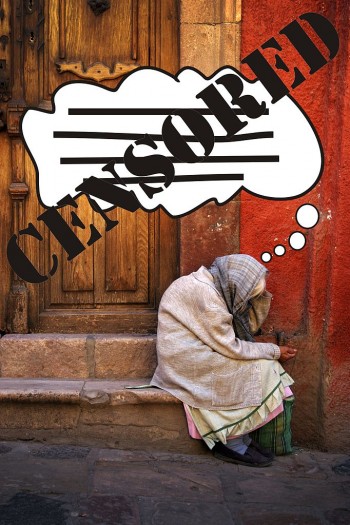
Oh, do I have your attention now? Good! Welcome to the real world and a discussion on banning censorship in the classroom, with a view towards helping you ‘occupy’ your teaching practice.
As teachers, we enjoy a certain authority granted to us by society to interact with our students towards the aim of helping them become fully functional individuals in the world and in society. To support this aim, our role in working with students is to foster awareness of their individual rights and freedoms, as well as appropriate ways to protect and defend them. But for communication skills, that would leave only violence. Enter the foreign language teacher.
Censorship in education reflects an intentional desire for the masses to make decisions in life that conform to a narrow range of choices and beliefs. It’s aim is to protect various social values, especially those of a closed society, that clearly are not adopted by the rest of the world. Obviously, if one chooses to learn a foreign language, then it’s safe to say that such societal norms are bound to come into question, wouldn’t you think?
It’s my opinion, that in many countries undergoing social, political or economic upheaval, it’s important we teachers help students, especially teenagers and some adolescents, to understand why riots and demonstrations are happening right outside their classroom. I would argue that it’s critical we stop babying our students and robbing them of any grasp of reality that would help them cope better with their lives once they leave the classroom. Regardless of their station or status in life, this might mean opening them up to alternate points of view, or helping them to defend their own. As always, it comes down to language and communication skills – part and parcel of what being a language ‘teacher’ demands.
Censorship in the classroom can lead to students having a narrow scope of the world and its citizens. And, the longer these blinders are left on, the more their ignorance grows. However, if we expect students to think critically about essay topics and to then expound on them, we need to teach them ‘how’ to do so by providing them with food for thought and regular opportunities to express their opinions. Otherwise, it’s just not going to happen.
Topics to facilitate this need must not only be controversial, but also relevant to the students, both personally and socially speaking. Through exposure to sociopolitical ‘current affairs’, we can help students become more effective participants in their social circles. By the same token, in failing to educate students about individual differences in society, we merely create very dysfunctional self-centered citizens.
If we don’t expose students to topics such as, for example, discrimination with regards to race, color, creed or sexual orientation, we can’t really expect students to cope with individuals and situations they may be personally confronted with. Moreover, by censoring a discussion on fascism, for example, we create a lopsided reality for our students … one in which fascists and racists alike have absolutely no problem dominating by readily disseminating their opinions and literature.
The same argument follows with regard to religion. It should go without saying that if a child is only exposed to the religion of his or her parents, he or she will have no frame of reference when relating to people of another faith. In a multi-cultural society composed of people of varying religions, such a child will not only be confused, alienated or even anti-social, but may eventually engage in acts and thoughts of bigotry.
Therefore, we should be encouraging our young students to engage with unbiased local sources of news and information about, not just the world around them, but how current affairs ultimately impact their lives, as well as those of their families and peers. Since the future belongs to them it’s imperative we stop distracting them from the realties of life with inconsequential pleasantries and vanilla flavored superficial contexts that might only exist in a Walt Disney World like magic kingdom … or perhaps in some modern commercially published course-books. It’s one thing to ‘ease children’ into the world. It’s another thing to keep them in denial.
Still, it goes without saying that we must protect our young, to some extent, by shielding them from many harsh realities of life. However, taken to extreme, this approach ultimately creates both educational and social deficits in students, especially if we are to assume that one aim of education is to create beings that both function and participate in society. This entails more than simply learning how to order tea in a restaurant or discuss the weather.
A discriminating look at course-books
As language teachers, we should therefore strive to stimulate our students use of the language by choosing material and contexts they can relate to … or at least to what ‘we’ assume might best match their interests. Nevertheless, this rarely occurs as material is often chosen on the strength of variables that have less to do with student interest or need, and more to do with ‘convenience’. Enter the course-book.
 Rather than interacting with our young learners, for example, many teachers simply allow a cavalcade of cartoon characters to supplant the teacher-student relationship. Moreover, and more often than not, such teachers surrender their judgment to that of course-book publishers and editors who obviously believe that fairies, superheroes and animals can relate better to young learners than teachers can.
It would be nice to know that ELT publishers have actually done some research into student motivation before choosing topics or characters of interest to fill their publications. Nevertheless, I’m sure you would be hard-pressed to find even one publisher that would be willing to share such research with the public.
Most commercial marketing material bleats about how a book’s range of language content is in line with this or that exam syndicate. It might even make reference to the Common European Framework of Reference. In logical terms, this sales ploy suggests that decision makers will fall victim to the fallacy of ‘an appeal to authority’. Yet, ask a publishing representative about the motivational factors that suggest why a fairy or superhero was chosen to appeal to young learners, and you are rewarded with either blank stares … or a one-size-fits-all comment such as “well, they’re children, aren’t they?”
As we all know, it’s commercial ‘mainstream media’ interests and toy manufacturers that suggest to us what children are motivated by, not science or academics. Their mission is to sell toys, television shows and all manners of superficial products to our unsuspecting, innocent and gullible youth. For ELT publishers, therefore, choosing a course-book theme for young learners requires no real thought. The decision comes down to what’s trendy at the moment; one year it might be a mermaid, another year it might be Mickey Mouse.
In a perfect world, a range of contexts to be covered in a classroom might be mutually agreed upon by parents, teachers and administration before an actual syllabus is written up. Unfortunately, the reality of many schools, especially private language schools, is that such decisions about syllabus design is blindly left to an ELT course-book publisher.
Here’s a test: if you are a parent, walk into a local language school and ask for their syllabus for your child’s age group and level of proficiency. If they even have one at all, it most likely mimics the ‘contents’ page of a course-book broken up week by week … but then some of you might know this already from your own teaching experience. Right?
Course-books are only material. Course-books do not teach; teachers do. As much as parents should be told to turn off the television and interact with their children, teachers need to be told to close the course-book and do the same.
If your only requirement in selecting a course-book for young learners is that it will help them pass a proficiency certificate exam a few years down the road, then you might as well give up teaching … and on your way out, don’t forget to throw such course-books in the trash.
Welcome to the ‘clash-room’!
One of the most vital functions of a foreign language teacher is to maximize students’ opportunities to use the taught language in a meaningful way, especial via tasks that foster fluency and confidence. This demands that at the production stage of the lesson, teachers support the use of open-ended speaking tasks which do not restrict expression, regardless of the topic. If we want our students to take ownership of the language, then we must create opportunities for them to do so in a personally meaningful way, and in a safe-environment that encourages confidence.
Confidence is only gained by trial. To this end, the ‘classroom’ must become a ‘clash room’ in which students are free to tryout their use of taught language expression, by expressing their opinions with their peers in an uninhibited way. Authority figures, such as the teacher, should have no role in such tasks.
The spirit of open dialogue should be encouraged and respected. Students should be taught to not censor or restrict their thoughts and speech. The teachers role is only to monitor. If possible, mediation of more extreme sentiment should be peer-based, not teacher-based. The teacher should appoint such roles to some students.
Supporting material, hopefully of an authentic nature, should be chosen on the basis that it can easily be customized to the contexts of its end-users, the students. Non-authentic material should be adapted, not respected.
Of course, it’s all too easy for foreign language teachers to say that the above is the responsibility of traditional educational institutions and that their domain is restricted to teaching expression, language skills, or in worst cases teaching test skills. Such a notion can’t be further from the truth. All of the above suggests creating free-thinking and confident users of a foreign language – an aim which can be assumed to mean speaking a foreign language with real live foreigners (native or non-native) and possibly in a real foreign land (as opposed to a magic kingdom).
Lastly, it is unfortunate that our young students will inherit the mess of this world we have created. It’s reprehensible enough to saddle them with this burden, but it’s even more appalling not to teach them how to deal with it constructively with a view towards ultimately unburdening themselves from our own shortcomings.
—————————-
Suggested Reading


 ELTvisa