
 Consider the following quotes and decide which statement is more aligned with your views of learning:
(A) “Never interrupt your enemy when he is making a mistake.” – Napoleon Bonaparte
(B) “Competition has been shown to be useful up to a certain point and no further, but cooperation, which is the thing we must strive for today, begins where competition leaves off.” – Franklin D. Roosevelt
Suffice it to say that I guess you all know where I’m going with this post! To what extent would you agree that competition is ‘healthy’ in the classroom?
The Nature Of The Game:
There are many reasons to consider using games in the language classroom. They are motivating, attention sustaining and certainly very useful for breaking the monotony of a long line of traditional practice tasks. They also contribute to the pace of the lesson. In some forms they offer opportunities for collaboration, and in other forms, with respects to learning styles, they may also support students with kinesthetic and interpersonal learning styles. Of course, any student will just flat-out tell you “they are fun”.
Indeed, everyone loves games and everyone loves winning. The only problem is that … everyone also happens to hate losing. This last point actually proves very problematic, and to be honest, should give many educators pause for consideration.
Competition: A builder of character?
It’s all too easy to figure out how you will reward the ‘winners’ of a competition. the real question is what do you do with the ‘losers’? In fact, I’d ask you to question what constitutes a ‘loser’ in your classroom? Do you define someone who answers a question wrongly – a ‘loser’?
It should go without saying that no student should ever be labeled ‘loser’ in our classrooms. Yet, that is exactly how anyone feels when losing a competition. In fact, in team competitions, the ‘goat’ not only has to take personal responsibility for his team mates, but also suffer the ire of their wrath. I think you would agree that this is not a ‘healthy’ situation anyone would want to experience, nor does it contribute to ones ‘character development’. Nevertheless, it happens everyday in classes across the globe.
When it comes to students we must take into account individual differences in terms of learning styles, interests, levels, personal and educational backgrounds, and personality. Psychologically speaking, there will always be ‘less competitive’ students in our classes, and we really can’t blame them for being who they are. In fact, students do not come to class to compete; they are there to learn.
As such, the aim of a game, if used as a task, must be getting students to practice or produce the ‘forms’ they are there to learn. Yet, all too often some students ‘shut down’ or ‘fold’ in competition. Moreover, those that don’t most likely make more mistakes in the chaotic rush to compete without really thinking. Since there can only be one winner, the end result is that most students’ ‘self esteem’ suffer, and accuracy, along with any real fluency practice, goes right out the window. I’m sure you will agree that this conclusion is not exactly what we bargain for when plan our lessons.
Win, Lose Or Draw?
What happens when you call on a student in class to answer a question, and he or she answers incorrectly? Your dismissively grimacing and turning to the next student in line is never indicated. When students don’t have the right answers, they should be led to them, so that they can master the point and feel good for their efforts, even when they start off on the side of error.
In fact, we often talk about the idea that errors are actually learning opportunities. Unfortunately, the nature of competition (in real-time) does not support this aim. If it did, there would be no such thing as ‘winners’. In terms of competitions, this sad fact just reflects the nature of the beast – and it’s often been said that competition does bring out ‘the beast’ in some.
To me, games in which students are eliminated are the worst form of tasks. Not only do the ‘losers’ experience the ‘agony of defeat’, but they also sit non-productively until a winner is found. I’d suggest that being told to “sit down” is offensive enough, even if the words “and shut up!” are only implied.
Too Much Of A Good Thing?
Once we start making every task a game complete with winners and losers, we will eventually find some students getting bored and discouraged for their lack of ‘succeeding’. In fact, even in the best of cases, I would argue that too much of a good thing … is a bad thing. I mean, we can’t really expect students to be ‘up’ and excited all through a lesson. It’s tiring for anyone to maintain such a high level of excitement for long expanses of time. This leads to high stress levels and eventual burnout.
Wake Up! It’s Time To Play A Game!
In the best situation, a game is played, as I mentioned above, to address the practice or production of a language target. In the worst case, a teacher desiring to wake his class up will use a game as a respite from the lesson grind to compensate for his own lack of classroom management skills. In doing so he is actually rewarding ‘undesired behavior‘ with an activity that is unrelated to the aims of the lesson. In other words, such a practice is really nothing more than a waste of time; when the game is over, students quickly revert to negative form and have learned nothing.
In worse cases, students refuse to participate in regular tasks unless the teacher promises them a game ‘afterward’ or ‘soon’. Drones of “can we play a game now?” are heard every ten minutes.
The above point also speaks volumes concerning the topic of behavior management in the classroom, and especially the efficacy of poor ‘positive reinforcement’ practices. Constantly offering students rewards for good behavior is a matter for another post, but for the time being please consider that we should never force students to compete for rewards, be they something tangible (candy) or intangible (your respect). ‘Losing’ is one thing, but ‘losing out on something’ is ten times worse! It not only breeds low self-esteem and envy, but even hostility in some.
It’s therefore extremely important we make all students feel like winners for their efforts. It’s one thing to end the class with a game as a production task, but during the lesson, emphasis should be placed on ensuring that all students are able to produce the language targets and feel good about their participation. Not all games need to be competitions where there are winners and losers.
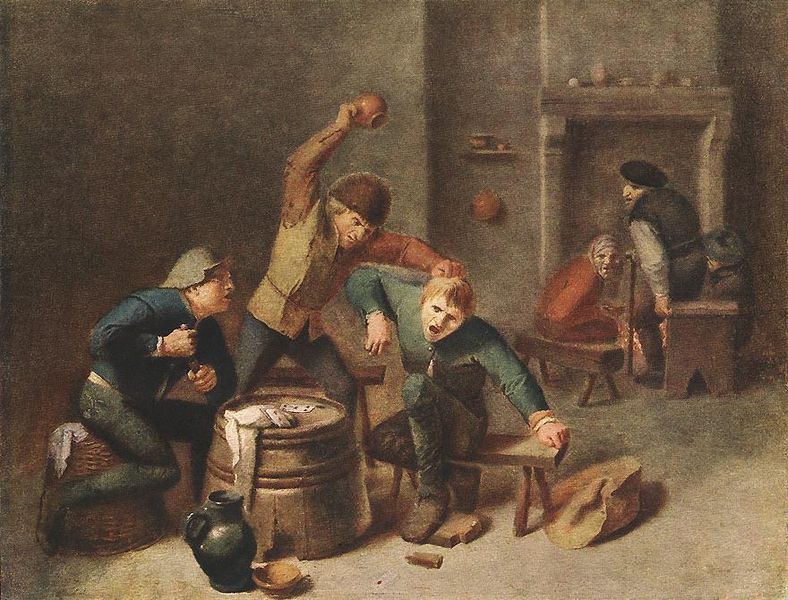 The Spirit of Competition of Cooperation?
It’s true to some extent that we live in a competitive world. Still the extent to which we compete in real life is usually a matter of choice. Yes, sometimes competition is thrust upon us, but what matters most, in my opinion, is how we respond to it and to the ‘others’ involved. So don’t get me wrong: I do advocate the use of games in the classroom when they serve the aims of the lesson. In this sense, the old saying, ‘It’s not whether you win or lose, it’s how you play the game’, certainly rings true.
Perhaps it’s utopian to think that fostering cooperation and collaboration is a better exercise than fostering competition. To some, the concept that competition actually does not enhance cooperation is radical, if not blasphemous – despite it being borne out in research, as well as in practice in the business arena many times over.
As teachers, even foreign language teachers, we like to think that our efforts in the classroom will also contribute to our students’ overall growth as individuals. And, that in turn such growth will help to influence and shape our societies, even the world, for the better. However, it begs the question of what kind of world we would like to contribute to; a more competitive one, or a more cooperative one? Ultimately, our contributions, in this sense, come back to the decisions we make in the classroom.
Lastly, ‘communication’ suggests at least two people cooperating towards a single aim. Competition, on the other hand, suggests two people talking over or at each other. One of these ideas is consummate with our aims in the classroom. The other is just plain stupid.
Further Reading:
- http://www.hltmag.co.uk/apr11/mart02.htm
- http://www.calstatela.edu/faculty/jshindl/cm/competition.htm
- http://www.alfiekohn.org/parenting/tcac.htm
Suggested Reading:


 ELTvisa