
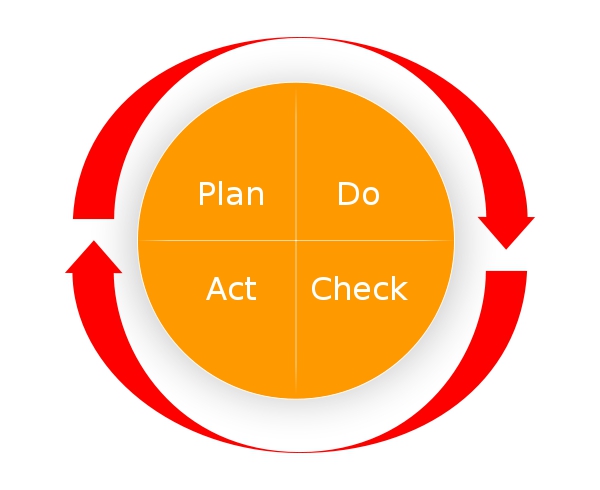
Quality Circle
What Is Quality Management? Do you really need it? Some claim to have it, others want it. Some offer it for a price, and others will ‘run for the hills’ if they hear word of it.
If you work in an organization long enough, eventually you will hear the terms ‘quality management’, ‘quality circle’ or ‘quality control’, as surely as you would hear the word ‘trendy’ if worked in the fashion industry. In fact, go to any bookstore, and you’ll find tons of books espousing all manners of theory and practice for business concerns.
If you own or work at a language school, you may very well have heard or read about quality schemes or quality affiliations. The notion of adopting a ‘quality’ scheme may trigger various ideas or objections in your mind. Here are a few I’ve come across in my consulting experience:
- “Quality?! Of course, I have quality! Are you suggesting I don’t?”
- “Nobody knows more about my business than me.”
- “All my students passed last year. If that’s not quality, I don’t know what is!”
- “Quality management has nothing to do with education. Teaching is an art, not a product.”
- “Sure, quality is important, but that’s something large institutions.”
- “Quality means control and I’m not interested in anyone telling me how to do my job better than I already do it.”
- “I’m a teacher. I have nothing to do with the operation of the school, and I’m certainly not paid to.”
- “Schools that are members of quality associations are elitists.”
- “Quality is something we all strive for in all parts of life. We don’t need to be told what quality is.”
- “Quality management is like that ISO-9000 thing. It’s for manufacturers, not educators.”
- “What the heck is a quality inspection? Who are the inspectors? Do you think they know more about my business than I do?”
- “Quality assurance via accreditation? Right! And I want to know is who accredits the accreditors?”
- “Quality is certainly a worth aim, but is it realistic?”
- “!$#! I’m a teacher! Not a !$#! business executive.”
So as you can see there is a lot of speculation, as well as confusion over what quality management is all about, and how establishing a quality scheme might affect a school and its stakeholders. Nevertheless, since it’s a given that the term ‘quality’ is universally understood as something positive and beneficial, I think we can all agree that it’s something to strive for. The real questions is how you get the ball rolling in your school without losing your sanity, staff or students.
To begin with I think it’s important to dispel some popular misconceptions about what establishing a quality management scheme entails:
- You don’t need to any specialized business knowledge or hold a Master’s Of Business Administration (MBA) degree.
- You don’t need to hire a special business consultant or marketing manager.
- You don’t need to affiliate yourself or your school to any exiting quality association for which you pay for the nose to join.
- You don’t need to have some external ‘seal or approval’ to claim quality.
- You don’t need to be inspected by an external body to claim quaility.
Moreover, bear in the mind the following misconceptions:
- If adopting a quality management scheme means that half your staff will go running for the ‘exit’ the following year, then you obviously have it all wrong.
- If adopting a quality scheme does not eventually translate into greater academic success for your students, greater staff satisfaction with their jobs, and greater earning potential for your school, then you have it all wrong.
- If adopting an external quality management scheme demands making a prohibitive financial investment in your school, then you have it all wrong.
- If adopting a quality management scheme means redefining your teachers as ‘service providers’ and your students as ‘customers’, then you have it all wrong., at least in my opinion.
- If the adoption of a quality scheme assumes a ‘one size fits all’ approach to quality assurance, then you have it all wrong.
A good quality scheme will certainly take into account the role of the teacher and the efficiency at which he or she facilitates learning. Moreover, a good scheme will also assess to what extent a student is actually getting what he or she paid for. A good scheme will not dehumanize these individuals for the sake of slavishly adhering to some doctrine of ‘good business’ or ‘best business practices’. In fact, a good quality scheme tends to evolve holistically from within the organization. It is not an external scheme that places a stranglehold on your staff, finances and operations.
 It’s a shame that all too often I’ve seen the application of quality management theories, designed to bolster school efficiency and staff morale, supplanted with authoritarian and draconian measures of ‘quality control’. Such measures create job dissatisfaction, promote disenfranchisement, and ultimately encourage a lack of productivity. It’s safe to say that such consequences do not reflect quality, and certainly not ‘quality of life’.
Bear in mind that quality is not an absolute requirement. In fact, it’s false to think that there is such a thing as ‘maximum’ quality. The needs of individual language schools differ as much as those of its students. Therefore, attempts to measure ‘quality’ in educational systems according to a ‘one size fits all’ benchmarking system is not only unproductive, but also dehumanizing.
I hope you will agree that education, for the most part, is not a ‘product’. School owners, like any business owners, must certainly watch their financial ‘bottom-line’, but not to the exclusion of other more humanistic measure of success. Certainly a school offers courses as ‘products’, but the teaching of those courses, the imparting of knowledge and facilitation of learning, is still an art.
For a long time, I’ve had in mind to create an easy to follow guide for private language school owners, together with their personnel, to establish and implement their own internal quality management scheme. Such a scheme would be highly personalized to the needs of the school, its staff and its students. It would facilitate teamwork and reflect a humanistic ‘people first’ approach. It would give emphasis to designing systems of operational efficiency, while at the same time support communication amongst peers. Lastly, it would instill a sense of pride and professionalism that most certainly will be noticed by potential students, and thus increase revenue. I hope you will follow this series as I lay out step by step what establishing your own quality scheme entails, and ultimately find reward for your efforts.
To wrap up this first installment, I’d like to leave you with the following task, until my next post on this subject. First, write down a few ideas on what ‘quality’ means to you. Then, go back and take a look at the quotes I listed above regarding people’s perception of quality schemes. Also, reread the misconceptions I listed above. Do you agree or disagree with any of these ideas or statements? Lastly, make a comment below on how you feel about ‘quality’ and how it relates to your experience. If you have ever been a part of school that adopted or established a quality scheme, please share your experience, for better or worse, with us.
Suggested Reading:


External Article Links:
In Search of Quality: Teachers as Service Providers and other Tales of Conspiracy
– (Jay Schwartz, Humanising Language Teaching, Year 9; Issue 1; January 07)
 ELTvisa
Pingback: Getting Started With Quality Management: Asking Teachers The Right Questions | ELT Vista